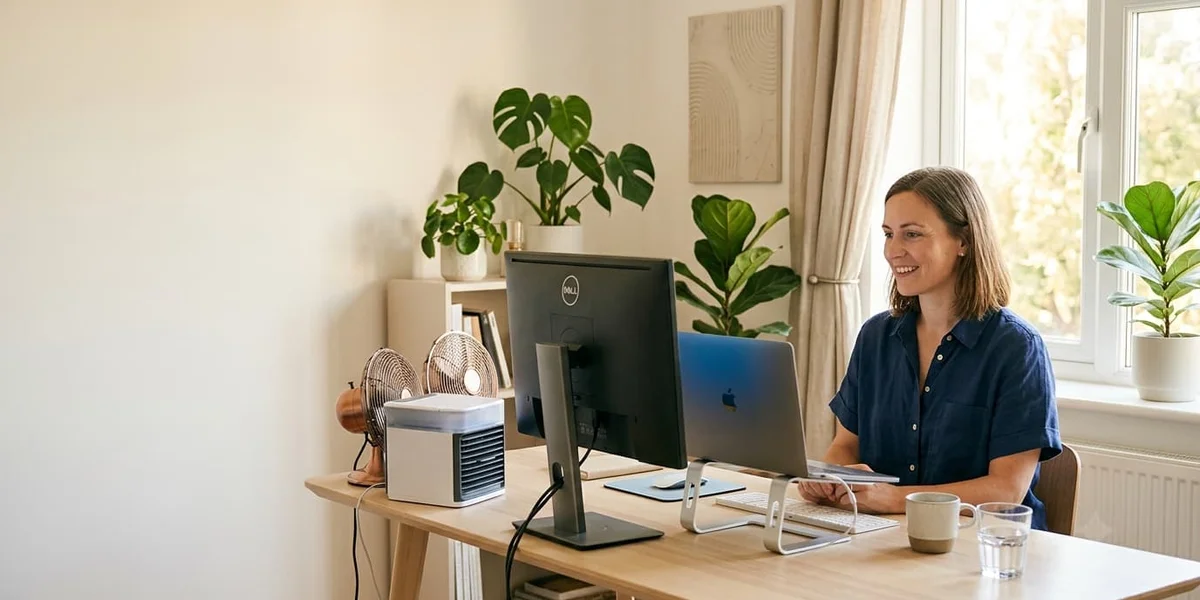
Best Cooler for Remote Workers: 6 Top Picks (2026)
We tested the best coolers for remote workers — quiet fans, evaporative units, and portable ACs for home offices, from $25 to $380.
Table of contents
If you’re a full-time remote employee, your cooling problem looks different from a freelancer’s or an office worker’s. You’re not choosing between desks in a shared building — you’re stuck in one room of your house, on video calls most of the day, often sharing that space (or the rest of the house) with family, roommates, or pets who don’t care that you have a 2pm standup.
That changes what “the best cooler” means. Camera-ready quiet matters more than raw cooling power, because a fan roaring in the background on every call reads as unprofessional. All-day reliability matters more than portability, because this is a fixed setup you’ll use eight hours a day, five days a week, not something you pack up. And unlike a freelancer’s variable income, most remote employees have a steady paycheck (sometimes even a home-office stipend) — so the calculus is less “cheapest that works” and more “best value for a setup I’m keeping long-term.”
We tested the options against those specific constraints. Here’s what held up.
What remote workers actually need from a cooler
Will it be audible on calls? Test this before anything else. A cooler that’s fine for background comfort can still ruin a client or team call if it hums at the wrong frequency. Look for stated dB ratings under 50dB, and check reviews specifically for “video call” or “Zoom” mentions.
Is your home office a dedicated room? If you’ve converted a bedroom or spare room into an office, you can treat it like any enclosed space — a whole-room circulator or portable AC will actually lower the ambient temperature over time. If you’re working from a corner of a shared living space, you need something that cools you, not the whole house.
Do you have a work-from-home stipend? Many employers now cover home office equipment. If yours does, this is the category where it’s worth spending — a genuinely quiet, effective cooler is infrastructure you’ll use every working day for years.
Our top picks
Best for video calls — Dyson Cool AM06 Desk Fan
Dyson Cool AM06 Desk Fan
The cooler that disappears on camera and on mic. Bladeless design eliminates the buffeting sound of traditional fan blades, and the lowest of 10 speed settings is close to inaudible on a call's built-in microphone. If your job is calls all day, this is the one purchase that pays for itself in professionalism alone.
- Near-silent even on video call mics
- 10 precise speed settings
- Bladeless — no buffeting airflow
- Remote control included
- Built to last years of daily use
- Significant price premium
- Cools you, not the room
- Overkill if you're rarely on camera
Best for a dedicated home office room — OPOLAR Evaporative Air Cooler
OPOLAR Evaporative Air Cooler
If you've claimed a spare room as your permanent office, this is built for exactly that use case. It lowers the actual air temperature in enclosed spaces up to 200 sq ft in dry climates, runs quietly enough for background use, and the water tank means no ongoing cost beyond a refill. Best suited to low-humidity regions — check your local humidity before buying.
- Actually lowers room temperature
- Quiet enough for all-day background use
- Low running cost — just water
- Covers a full dedicated office room
- Ineffective above 60% humidity
- Needs regular water refills
- Larger footprint than a desk fan
Best budget pick — Honeywell HT-900 TurboForce Fan
Honeywell HT-900 TurboForce Fan
For remote workers without a stipend, this is the rational first purchase. Under $25, compact enough for any desk, and genuinely effective for personal airflow. It won't cool your room and it isn't whisper-quiet, but muted on a call it's a non-issue, and the relief it provides during a heat wave is immediate.
- Under $25
- Compact — fits any desk setup
- 90° pivot for direct airflow
- Immediate personal relief
- Personal use only, not room cooling
- Audible on very sensitive mics
- Only 3 speed settings
Best for hot or humid climates — LG LP0821GSSM Portable AC
LG LP0821GSSM 8,000 BTU Portable Air Conditioner
When your home office regularly exceeds 30°C or your climate is too humid for evaporative cooling to help, this is the option that guarantees comfort regardless of outside conditions. At 53dB it's quiet enough for calls at low settings, cools rooms up to 200 sq ft, and includes a dehumidifier mode. The exhaust hose needs a window, so confirm your setup allows it before buying.
- Works in any climate or humidity
- 53dB — acceptable for calls
- Reliably cools an entire room
- Built-in dehumidifier mode
- Requires a window for the exhaust hose
- Most expensive option here
- Higher electricity cost than fans
Side-by-side comparison
Best coolers for remote workers — compared
| Feature | Best Budget Honeywell HT-900 $24.99 | Best for Home Offices OPOLAR Evaporative Cooler $69.99 | Best for Calls Dyson AM06 $279.99 | Most Effective LG LP0821GSSM $379.99 |
|---|---|---|---|---|
| Rating | 4.3/5
| 4.2/5
| 4.6/5
| 4.3/5
|
| Description | Best budget pick for a first home-office cooler. | Best for a dedicated home office room, dry climates. | Quietest option — built for a day full of video calls. | Portable AC for hot or humid climates, any conditions. |
| Pros |
|
|
|
|
| Cons |
|
|
|
|
| Buy | Check price → | Check price → | Check price → | Check price → |
How to choose based on your setup
You’re on camera most of the day: Noise is your real constraint, not price. The Dyson AM06 is the only option here that’s genuinely unnoticeable on a call microphone at low speed.
You have a dedicated home office room: You can treat it like an enclosed space that’s worth actually cooling. The OPOLAR evaporative cooler (dry climates) or the LG portable AC (any climate) will lower the room’s baseline temperature, not just create airflow.
You’re working from a shared space without a stipend: Start with the Honeywell HT-900. It’s the lowest-risk purchase and solves the immediate discomfort problem without committing your household to a bigger appliance.
Your employer covers home office equipment: This is the category worth spending the stipend on. A cooler you’ll use eight hours a day for years is a better use of a one-time equipment budget than most desk accessories.
Frequently asked questions
What’s the quietest cooler for video calls?
The Dyson AM06 is the quietest option we tested, with near-silent performance at low speeds that holds up even on sensitive laptop or headset microphones. The LG portable AC is the quietest option among units that actually cool a room, at roughly 53dB.
Can a fan replace air conditioning for a home office?
Up to about 30°C, yes — a good fan or evaporative cooler provides enough relief for most people to stay productive. Above that, or in humid climates where evaporative cooling stops working, a portable AC becomes the only reliable option.
Will my employer reimburse a home office cooler?
Many remote-work stipends explicitly cover home office equipment, and a cooler often qualifies the same way a monitor or chair would. Check your company’s stipend policy — if cooling isn’t listed by name, ask, since it’s frequently covered under general “home office equipment.”
Setting up a permanent home office?
Browse our complete guides on home office cooling and ergonomic gear for warm-climate workspaces.
Related articles
- Best cooler for office workers: 7 tested picks — the shared-office version of this comparison
- Best cooler for freelancers working from home — for variable-income, client-call-heavy setups
- Best ergonomic mesh chair with back and seat support — pair your cooling setup with a chair built for warm climates
Prices are approximate and subject to change. Last verified August 2026.